—Lao Tzu, Tao Te Ching, chapter 65; trans. Stephen Mitchell
“All that I know is that I know nothing.”
—attributed to Socrates.
It is easy to fall in to a trap in teaching, and that trap is thinking that we have to know everything. After all, education is part of the “knowledge economy.” Knowledge is what we have acquired in graduate school, through hours and hours of reading and research. Knowledge is what we disseminate through writing. Knowledge is what makes up the various “disciplines” in which we are nominally experts. And knowledge is a great deal of what we claim to impart to our students. In a less lofty vein, I’m reminded of some of the earliest advice I received as a graduate teaching assistant: “Oh, just stay a week or two ahead of the students in the readings.” In other words: stay ahead in knowledge.
It all easily adds up to the vision of the teacher as “the sage on the stage,” as the saying goes, the one holding forth and dispensing important content and/or analysis to an audience of the less informed. The work of teaching then becomes to organize all that knowledge in an easily-communicable way. And the work of preparation becomes amassing that knowledge, to be ready in case any questions come up. The sage on the stage – the expert – must know it all.
Except that Lao Tzu, was a sage, too. But he actively shunned stages, and, as above, advocated “not-knowing.” Likewise Socrates, who loved a good holding-forth to an audience as much as anyone, is famously said to have declared just how little he knew.
Perhaps these two are showing us another way.
What might it look like if we framed teaching as an exercise in not knowing?
I have written on this site before about the formative experience of having one of my graduate school mentors publicly not-know along with us his students: “I don’t know that,” he said when asked a question about a text. “Why don’t we find it out together?” I was floored and I was invigorated and I filed it away for future reference: a teacher can do that. And of course in the long view I realize I thought no less of him for that at the time – but rather have come to think more and more of him for it as I have moved through my own teaching career. On the most basic level, not-knowing in teaching is simply a matter of honesty; it is the courage to own up to our limits in front of our students. We cannot be ready for every question. We can never know it all. No one can. This in itself is a quality lesson.
On another level, however, not-knowing in teaching is the courage to own up to the limits of knowledge, period – and to own up to how much those limits inform what we do. I would suggest that if, as academics and instructors, we are experts in “lifelong learning” for ourselves and others, that what we are really experts in is not-knowing. I would suggest that the “disciplines” we learn can be understood as the practices of not-knowing constructively about the content they embrace. What is research driven by, after all, except for our not-knowing about something…and our desire to not know about it somewhat less?
There is an old story about a professor who visits a Zen master, and begins holding forth, glad to have found an astute dialogue partner. On and on he goes about how he has studied enlightenment in many faiths and is so happy to visit the master and hear his opinion, expert to expert. The master says nothing, but pours the scholar a cup of tea…and keeps on pouring, as the tea spills over the top and all over the table.
“Stop, stop!” cries the professor. “Are you crazy? What are you doing??”
“You, sir,” says the master, “are like this cup. Full to overflowing of what you know. How can I add any more to an overfilled cup?”
And the scholar shuts up.
The Zen master here reminds us that not-knowing is a matter of leaving space. And mental space is the drive behind curiosity. There are things we do not know. So we seek to know them. If we run out of the space created by not-knowing, like the talkative professor with his tea, we run out of the ability to learn.
What would it look like to tell our students that we are here to “kindly teach them to not-know?” I think a first result might be to relieve all of us of more than a little pressure. Perhaps none of us would feel as much drive to cram our heads with as much content as possible to head off questions, and instead we would consciously leave space exactly for questions. And a second, and related, result might be an awareness that the generation of questions is as valuable as the generation of answers. Can you imagine assignments based around demonstrating what you do not know, instead of what you do? What could that look like? How might you encourage your students to empty some space in their cups? How might you start a class by emptying some space in your own cup?
This is not to say that there will never be a time for holding forth and dispensing information or analysis. Even Zen masters and Taoist sages told stories and wrote poems and books. It is rather to say that there is something to be gained by turning the usual trope of amassing knowledge on its head. Mystics refer to this sort of thing as the apophatic path to the divine – getting closer to God by contemplating how little God can be known, often by cataloging things God is not. The point is to strip away a sense of false security – to empty one’s cup, as it were – and aim for a direct experience of the divine with an uncluttered mind. This path exists beside the cataphatic path – which contemplates instead all the things the divine is. Different mystics wrote about both; both have value and both lead practitioners closer to the Truth. We may not be aiming for any sort of mystical experience in our classrooms – but we can learn from the mystics that sometimes there is something divine about not-knowing.
It is often said that, in teaching, everyone needs “someone to borrow from and someone to complain to.” Or, actually, less politely (and more honestly?), “someone to steal from and someone to bitch to.”
I believe this is fair.
As to the first part, I’d imagine you, dear reader, would not argue – after all, you’re reading over a teaching-related blog for advice, tips, or useful experiences. We all do this. We learn, we see, we observe a technique, a plan, an activity, an analogy somewhere, and we take it for our own. Sometimes we even give attribution. This is part of how teaching is also always learning. We can always do better. We can always try something new. We can always benefit from the experience of others. In the words of Ram Dass, “when you know how to listen, everybody is the guru.”
It’s the second part that can be a bit trickier, if sometimes no less necessary. Sometimes we just have to let off steam, and do so to someone who shares our context. Teaching is a unique profession with unique concerns, and it’s good to have a trusted friend who knows and understands those concerns. In “bitching to” them, we often learn that we are not alone in our struggles, that someone else has been where we are, and that they’ve lived to tell the tale. Or we learn that our worries about a policy, a course, an institutional structure, or a workplace relationship are shared and reasonable (or, in some best cases, not shared and unfounded). There is, to be clear, nothing wrong with an occasional “bitch session.”
However, I have learned that the “complain to” option can be a slippery slope. As an engaged teacher and faculty member surrounded by fellow engaged teachers and faculty members, I talked a lot at my former college about how things were going. Eventually, I noticed something – there was a real tendency for those conversations to turn negative very quickly. Of course we headed for problem areas first – we were problem-solving people. It struck me at some point, though, that, without trying, complaint had become a reflex. Almost all our work-related chats struck a negative note. Something seemed amiss, but I couldn’t name it.
Then something else happened. Our college administration called a group of us who were department chairs, area heads, and program directors together to meet with visiting admissions consultants. They asked us what we did – especially what we did well (clearly with the intent to sell it, but that’s not the point). And 45 minutes later, I noted something. The same group of people whose talks usually leaned toward “bitching” had in fact spent nearly an hour talking positively, together, about our school. I noted two additional things: firstly, the even starker realization that we had hardly ever done this on our own, and, secondly, that I was walking away with a far better understanding of the identity of our college – a place I had worked for over a decade!
The consultant partnership did not pan out. But the lessons of that experience stayed with me: that though we know it in theory, in practice, the difference between critique and criticism is easy to cross, and that, in any assessment, you have a stronger sense of who you are if you start with the positives.
Lest this seem like silly optimism, consider – to start with what is wrong or what could be better is to literally start with nothing, that is, to start with what’s lacking, and, in a real sense not there. To start with positives is to start with something that is there – in other words, with an actual foundation. To start with the positive is to start with a strong sense of identity; to start with the negative is to start with a sense of identity crisis.
“To truly lead, you have to be clear on who you are,” writes leadership coach Jim McPartlin. And he, too, suggests starting with the good. “First, lead with the positive. What do you most value about yourself?” He suggests making a list yourself – and also asking trusted friends and colleagues to positively describe you. Only then do you move on to the problems, which McPartlin calls “blind spots.” “True leadership,” he explains, “means having a strong sense of both [your] attributes and the patterns that create [your] blind spots.” My realization after the admissions meeting was how often and how easily my colleagues and I had only focused on the latter. Which had only told us who we weren’t – not who we were. And without a sense of who we are, it is easy to lack purpose and motivation. Hidden in what we do well are the truths of our mission and vision, because we do well what we devote time, energy, and passion to.
Pop-culture-savvy readers may have caught the allusion in my title to the Lizzo song “Truth Hurts,” wherein she sings: “I just took a DNA test, turns out I’m 100% that bitch.” Silly? Sure – but it reflects (as much of Lizzo’s music does) a strong sense of identity. In fact, that song is an assessment of past and current lovers – and one that starts from a strong sense of who she is. She can assess strongly because she knows who she is and what she wants.
What I’m arguing for is developing the habit of beginning all assessments that way. Recently, I moderated a town hall meeting in a church setting. It was the second of two. I decided to begin as suggested here – first of all, what were we doing right as a church? Many good answers followed. Only then did I ask what could be improved. Afterward, I was told that this second meeting was much less contentious than the first (which I could not attend). That may have been simply because grievances were aired already. But I like to think it had to do with how the discussion was framed. Because I’m 100% that guy.
Things to think about:
How do you frame assessments of your own work, courses, or even yourself? Do you find yourself drifting to the negative? Why?
What might it be like to begin meetings, class sessions, or workshops with a short gratitude exercise?
What practices do you use to direct your attention? To direct the attention of your students? Do you tend to look for problems? For solutions? For things to appreciate?
We’re all familiar with things like the “praise sandwich” in grading and commenting. Do you consider the ratio of positive to negative feedback you give students? What feedback do you encourage them to give each other?
Where do you spend most of your time & energy in your teaching? In your own work? What might this say about your priorities?
How would you describe yourself in what I might call “Lizzo-ese?” What “percentages” are you composed of as a teacher? As a person?
To go a little further:
McPartlin’s advice, along with many other interesting and productive exercises, can be found in his book The Enneagram at Work: Unlocking the Power of Type to Lead and Succeed.
The Ram Dass quote comes from his famous book Be Here Now.
An easy way to get started focusing on the positive is by keeping a “gratitude journal” wherein you record daily, weekly, or on some other schedule, things that make you happy.
Relatedly, the NPR podcastPop Culture Happy Hour has a recurring segment on “What’s making us happy this week.” Not only are those a fun listen, but I intend to steal some version of that as a class exercise someday.
Kenosis is a fancy Greek word for “emptying,” and it is used in the Christian tradition to denote the self-effacing act of Christ, the second person of the divine Trinity, in taking on human form (in Jesus of Nazareth). It is part and parcel of the Incarnation, which Christians view as key to Christ’s saving work. It is through embracing humanity’s imperfect nature, and suffering the worst that nature has to offer, that Christ brings salvation (there are many different explanations of how this works; that’s a whole thing for another time – just know that Christians as a whole believe it does work). The classic statement of kenosis is found in the Apostle Paul’s letter to the Philippians, where he quotes what most scholars believe is an early Christian hymn:
Let the same mind be in you that was in Christ Jesus,
who, though he was in the form of God, did not regard equality with God as something to be exploited,
but emptied himself, taking the form of a slave, being born in human likeness. And being found in human form,
he humbled himself and became obedient to the point of death— even death on a cross.
Therefore God also highly exalted him and gave him the name that is above every name,
so that at the name of Jesus every knee should bend, in heaven and on earth and under the earth,
and every tongue should confess that Jesus Christ is Lord, to the glory of God the Father. (Philippians 2:5-11, NRSV)
Important things to note here are: 1) Christ, as Christ, has power and standing; 2) Christ best uses that power and standing by giving it up in taking on human form; 3) that form is described as a “slave,” serving others and putting them first; and 4) the giving up of power and standing ultimately leads to greater power and standing (to give up is, ultimately, to receive). Given this, I think a good way to define kenosis is as “a kind of giving humility.” It is not a false or self-deprecating humility, but a self-giving humility. It keeps the big picture in mind, and it keeps other people in mind. This is exemplified in Jesus’s own teachings:
…one of them, a lawyer, asked him a question to test him.
‘Teacher, which commandment in the law is the greatest?’
He said to him, ” “You shall love the Lord your God with all your heart, and with all your soul, and with all your mind.’
This is the greatest and first commandment. And a second is like it: “You shall love your neighbor as yourself.’ On these two commandments hang all the law and the prophets.” (Matthew 22:35-40, NRSV)
The commandments Jesus highlights focus on a person’s relationship to the big picture (love and worship God) and their relationship to others (love and care for the neighbor as for the self). Which is to say that Christianity shows Jesus practicing what he preaches, and vice-versa: kenosis. Good things happen when we give, when we have a proper perspective, and when we keep others in mind. Power comes from service and not from ego. And, as the followers of Jesus see it, these patterns are the shape of God’s own interaction with humanity. To do as Jesus did and said is to become a part of the repair of the world and the human condition. This is not just good advice – it’s how the world works (when it works properly).
Now, what can we take from these teachings on kenosis to use in our teaching? What would it mean to take a concept of giving humility into the classroom? Again, it should not be taken as a call to false modesty. We should always model honesty and appropriate self-confidence to our students. And obviously “giving up” here means yielding and not despairing! It is worth noting, however, that we live surrounded by a rather ego-driven culture – especially in the academy – where personal accomplishments matter and there is pressure to stand out. One of the things teaching with kenosis in mind can do is challenge us to present a different model of accomplishment. What does it mean to not think of standing as something to be exploited, even for lines on a CV? What sort of big-picture values are we holding up as important? How do we serve our students and help them to serve each other? What are we willing to give up in the short term in order to gain more in the long term? These are some questions this Christian ideal challenges us to ask. What might it mean to teach with the “mind of Christ” that Paul describes?
Passion – I realize “passion” is another loaded term in Christianity. Here, though, I mean it as simply a sense of what matters. In terms of Jesus’s first commandment, it means loving something with all your heart, soul, and mind. Obviously students’ personal relationships with any (or no) higher power are not usually matters for classroom experience (though I have had them come up in office hours!). We can, however, use time in the classroom to let students express and reflect on what really does matter to them. I have often started lessons about myths or American culture or simply storytelling by asking students, “Why are you here? Not just in this class, but at college at all? Why is it important?” Answers of course vary, and there is no right one – it is an exercise in calling to mind what things they value, and thinking a little about where those values come from. Hopefully, questions like those also encourage students to see what they care about as connected to bigger things – their families, their culture, their time management, and also our class. One of the hardest things for me to get over as a young teacher was the belief that I had to compartmentalize myself, and keep all the non-school parts of my life out of teaching. Not true. Healthy boundaries are good, but I also learned that students respond to whole people. They like to know what I’m into. They laugh when I, an amateur actor and veteran bedtime-story-reader, sometimes use silly voices in lectures or when reading texts aloud. They’re surprised when I know the names of current musical acts. And so on. One of the best lessons we can give students is that it is OK to care – about family, about a career, about music, about plants, about pets, about voting rights, about vegetarianism, or anything else. What would you give everything up for? Again – I do not believe that we should teach particular answers to that question; I do believe that we should teach that you should have a particular answer, and provide tools to reflect on it.
Kindness – I always concluded the classroom behavior portion of my first-day routine by saying, “If nothing else, make the rest of us glad you’re here.” Teaching with kenosis in mind can help extend that sentiment. It encourages us to never forget that we are surrounded by, and thus affect and are affected by, other people. Class dynamic is a tricky thing to create and police. Often, it has to happen organically. But I try to do what I can to remind students that we are all in this together. I employ a lot of group work, and that can help. But I also try to encourage peer feedback and interaction on assignments, presentations, and so on. Students should not think of classmates as competition; the competition is with themselves and their own mastery of skills and material – and they should feel free to help one another with those (as long as credit is given where due! Kenosis, yes; stealing, no!). And as valuable as exposure to diversity is, it is also worth spending some time getting students to notice what they have in common – shared values, shared goals, shared experiences. They share this particular class meeting, if nothing else! It’s worth pondering how we might underline the fact that learning together is a common good. I think students have a stronger sense of this now, after COVID-19 forced many of them out of traditional classroom settings. If passion is about bringing your whole self to class, kindness is about the willingness to share that self with others, and to be shared with in return.
Self-checks and self-care – Jesus does say “Love your neighbor as yourself.” Teaching with that in mind is also a challenge to encourage and enable students to take care of themselves, both in and out of the classroom. In class, this may mean providing time to start or catch up on work or even building self-evaluations into assignments. We aren’t with students outside of class, but we can respect their experiences and offer the help we can with time management, access to resources, or just time to talk and reflect. One of the best things we can do is underline the “as yourself” for ourselves and let students see us model good self-care, healthy boundaries, and honest accountability in our own lives. We, too, must practice what we preach/teach.
Humility – This can be a hard one for teachers to learn – after all, we’re up in front there exactly because of our expertise, authority, and hard work. But. We must avoid the trap that we are there to pass on ourselves to our students rather than the skills or content at hand. Power and standing are not things to be exploited! I have always maintained that, as a teacher, I am in the weird business of making myself less necessary. I have, in fact, actually made yielding the class to students an end-of-the-semester exercise for all of us. “We’ve done this for a semester – so you get to lead the last three classes on [topic x]. I’ll revert to student mode.” It is an assignment – they have to work together and turn in written lesson plans – but it’s more than that. This is a valuable way for me to see if they have internalized concepts and methods, but it’s also a valuable vote of confidence and a valuable talk for all concerned to spend a while in others’ shoes. Yes, I always come in for some gentle ribbing as students crib my methods and exercises. The look of satisfaction of the leaders’ faces and the often impressed looks on their “students’” faces are worth it. And I have given my students an example of humility – of being willing to give up sole control of the class. Humility like this, I hope, builds empathy. I also hope it reinforces that the whole point of the course was not to make Dr. Craig happy, but to enable them to know and do things. “Humility,” wrote Thomas Merton, “is the surest sign of strength.” This is because a humble person knows the big picture. For Merton, a Christian monk, that was of course “the power of God.” But it can be anything. Real humility – not false modesty – is rooted in confidence. True giving humility recognizes an answer that passion question. What would you give it all up for? And then puts its money where its mouth is. It’s a powerful goal, and a powerful lesson.
A caution – Taken to a certain extreme, all this “giving up for others” talk can lead to martyrdom. Martyrs are an important part of the history of Christianity – but they are not what I aim to make in the classroom. No one wants to breed resentment or burnout. We should not create these things. We should try hard not to model these things. Giving is not the same as having no boundaries. Care for others should never replace care for the self. Love for others should be collaborative and not overwhelming. Be honest with yourself and your students about where you are, and what is expected.
Reflection Questions:
What are you passionate about? How do these passions influence your teaching?
Do you know what your students are passionate about? What opportunities do you give them in your courses to bring those passions to the table?
What values does your daily class practice promote? Have you ever thought about this? What do you think your students would say is important to you? Why?
Do you encourage students to work together? What would this encouragement look like as part of assignments? What would it look like as part of daily class experience?
Do you consciously model humility in your teaching? If so, how? If not, how might you try working that in?
What are some of the hardest aspects of teaching for you to “give up” control over? What are you afraid would happen if you did?
What can you do to help students care for each other and themselves? Don’t forget to respect your own comfort level here!
What do you feel confident about in your teaching? How do you lean into those factors? Do you think students can tell?
To go a little deeper:
The Merton quote is from his New Seeds of Contemplation. It is mostly about monastic and spiritual practices, but if you like this blog series’ theme of adapting such practices to teaching, you’ll find food for thought there.
Another interesting book on Christian community is Dietrich Bonhoeffer’s Life Together. Bonhoeffer is someone whose Christian faith led him to martyrdom in a Nazi camp, and his life story is worth discussing.
One more figure you might base some reflection or discussion on is Fred Rogers, whose “Mister Rogers’ Neighborhood” combined literal neighborliness with educational emphases. Or, for that matter, “Sesame Street.” You might ask students why such “neighbor talk” is suited to educational programming…
Yes, there’s a question mark in this entry’s title. That’s not a mistake. But more on that later.
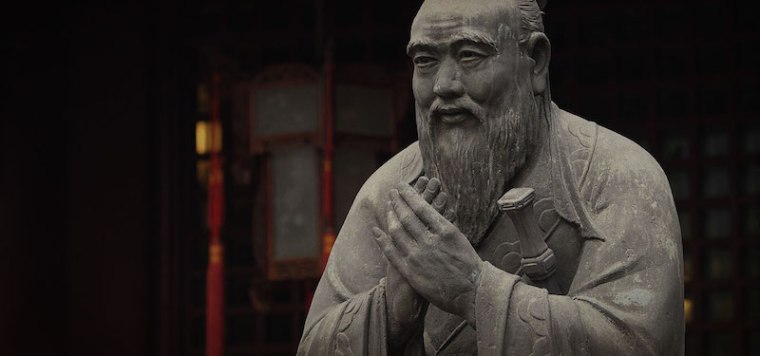
Filial piety is a key virtue of Confucianism. Confucianism is, in some ways, a counterpoint religion to Taoism, which I wrote about earlier. Both believe in the fundamental nature of a Tao, or Way (both in the sense of a path and a manner of doing). Both believe in structuring one’s life after the pattern of that Tao. They differ, though, on what the Tao is. For Taoists, the Tao is the Way of Nature – the way in which natural forces act and interact. For Confucians, the Tao is the Way of Civilization – the way in which civilized, cultured humans act and interact. It is very much “the way things are done around here.”
Confucianism is based in the teachings of Confucius (Kung Fu-tse), a Chinese sage who was born (most likely) in the 6th Century BCE. Confucius was a teacher. An upper-class man himself, he was charged with teaching the sons of his fellow noblemen the virtues and practices proper to their class. Confucius was decidedly conservative in outlook; he believed that the Tao was best exemplified in the ways of legendary rulers who lived centuries before his birth (much in the ways that European views of chivalry got traced to mythical figures like King Arthur). About his own teaching, he is reputed to have said, “I am a transmitter, not an innovator.” The Tao of Confucius, in other words, is very much about tradition. It is also about proper action. Confucius is known for a formulation of the Golden Rule (“Do not do to others what you would not want them to do to you”), but he also emphasized what is known as the rectification of names, or, essentially, “getting your place right.” This means knowing how to act properly in social situations, whether at home with family or at court with royalty. The Confucian Tao is in some ways a raising of etiquette to a way of life.
This means that Confucianism has already been mined elsewhere for workplace insights, as well as just good manners. I want to zero in on the virtue of filial piety because it is an unusual one in the Western world. Filial piety is the proper devotion shown by a child (for Confucius, particularly a son) toward a parent. It is a combination of respect and imitation. Here are a few sayings from the Analects of Confucius that help fill it out:
“Behave in such a way that your father and mother have no anxiety about you, except concerning your health.” (2.6)
“If for the whole three years of [socially prescribed] mourning a son manages to carry on the household exactly as in his father’s day, then he is a good son indeed.” (4.20)
“A young man’s duty is to behave well to his parents at home and to his elders abroad…” (1.6)
“Those who when young show no respect to their elders achieve nothing worth mentioning when they grow up.” (14.46)
In our culture, we often think of rebelling against our parents’ ways as a means to distinguish ourselves. Not so here. Parents deserve respect, and should repay respect with care and mentorship (this is also the template for good government – Confucianism literalizes the metaphor of a ruler as “father of the country”). Children distinguish themselves by embracing, living, and passing on what their elders have done. This is actually not so foreign a concept as we think. I would often begin lessons on Confucianism by asking my students etiquette questions: What should you wear to a funeral? What should you not wear to a wedding? How do you negotiate all those forks at a formal dinner? Who opens doors for whom on a date? And so on. Then I’d ask how they knew their answers. The replies were almost always (give or take a high-school course of some kind) “from my mom/dad/grandmother/grandfather.” My rebellious young people were a lot more used to following their elders’ patterns than they realized!
Filial piety represents a major theme in Confucianism – the importance of knowing and carrying out traditions because traditions encapsulate important knowledge. Confucius realized that our traditions make us who we are, for better and for worse. To be aware of tradition is to not feel the need to reinvent the wheel, and also to understand how we are indebted to those who came before us. Confucius would have agreed with T. S. Eliot when he wrote: “Some one said: ‘The dead writers are remote from us because we know so much more than they did.’ Precisely, and they are that which we know.” Our parents and their parents and their parents form a great deal of what we know, and what we do.
How might we adapt Confucian ideas about filial piety for teaching? Obviously, Confucius was himself a teacher, and what we have collected in the Analects are bits of his lessons. There is much to recommend good manners in the classroom, and, as I said, Confucius’s ideals are often held up as ways to get along with others. The focus on filial piety, though, allows us to zero in on the concept of tradition, and how that concept factors into what and how we teach. What is a tradition? What traditions are we, our subject matter, and our students parts of? How do we know? What does that mean for us? Who are our pedagogical “parents,” and how are we relating to them? Here are some things we might gain from teaching with an eye on filial piety:
Respect – It’s best to start where Confucius does, with respect for traditions. Innovation is a good thing in teaching, but any good teacher also knows you need to master the fundamentals first. Confucius believed that there were certain things a gentleman simply should know to be a civilized person. Something like this also lies behind the Liberal Arts in the Western world – historically, these were the areas of study that “liberated” people to pursue a good life. Filial piety in our academic setting means respecting what has come before, and emphasizing that there is more to what our students study than checking boxes for graduation. “Well-rounded” is not just a word for resumes. It is a goal of education as a whole. Our traditions last for a reason. Ideally, we are passing on those things that make us better, more civilized people. Part of this respect is also reminding students that they do not study in a vacuum. The reason for research is to become aware of what others have said and thought about the very same things they are studying now. There is a reason to learn the specialized terms and practices and formats of your chosen discipline – they mark you as being part of the tradition of that discipline. What might it mean to think of MLA format not as a way to pacify grumpy English professors, but as carrying on the ways of your literature-studying mothers and fathers? Jobs, too, have traditions – and learning early to recognize and embody traditions is good preparation for any field.
Relationship – Tradition isn’t a dead thing for Confucius. It’s based in interactions (reciprocity is another key Confucian value). With filial piety in mind, we can also work to help our students (and ourselves!) not just “study” traditions, but interact with them. Like my students who realized more of their ancestors’ ways lived on in them than they might have thought, we can look for surprising ways that the past remains relatable. I often told students in my literature courses that much of our concept of “genius” goes back to the Romantic Age – the person so full of passion and insight that it has to overflow into creativity. Your friend who stays up all night recording songs in her home studio is carrying on that tradition. This orientation encourages students to not think of subject matter as something only in a book or in a box in some kind of academic museum, but as something to interact with. The past is, as has been famously said, “a foreign country” insofar as it is different from our time – but inasmuch as it is our past, we are bound (as Eliot hinted) to have some familiarities with it. Are Greek funeral games in the Iliad so different from how we remember our sports stars, like Kobe Bryant or John Madden? Can you see your high-school dating life in A Midsummer Night’s Dream? It is easy to call things classic, important, or timeless without really delving into why. Confucian filial piety encourages us to specifically look for what is good about what we bring forward from our ancestors.
Constructive Criticism – but here’s where the question mark in the title comes in. As indebted as we are to our ancestors, we also all know that “because that’s how we’ve always done it” can be a terrible justification for action. Confucius saw carrying forward the ways of the ancients as a path to goodness. From our standpoint, we should use that standard also to critique what we bring forward. Just as we look for what is positive and enriching in our traditions, we should encourage students not to be afraid of also looking for what is negative or harmful in those traditions. Confucius was a conservative, but he was also an educator. Another of his sayings is, “He who learns but does not think is lost. He who thinks but does not learn is great danger.” There is, in other words, need for both taking in content and reflecting on it. And because traditions are living things, they can adapt. It is not a matter of completely rejecting or accepting tradition, but considering what in the tradition is a path toward greater civilization and goodness (and paths meander and shift). To think in terms of a relationship of filial piety is to think in terms of interacting with the “family” that preceded us, and families (I don’t have to tell you) are complicated. Plus, Confucius does not address how to judge a good son when the three mourning years are done. At some point, he becomes the new father figure whose ways will be emulated. How should he act then? What will encourage his children toward greater goodness, reciprocity, and liberation? How do we best honor our elders? By mere imitation? By building on their intentions? By correcting and refining their ideas? There are the beginnings of many hard but good conversations here.
Reflection questions:
What traditions are important to what you teach? How mindful are you of them when you design and run classes?
What traditions are you and your students parts of beyond the classroom? Family traditions? Political traditions? Religious traditions? Traditions related to sports, hobbies, or other activities? Are you aware of how you bring these traditions to your teaching and learning?
Do you ever discuss with students why the content of your course is what it is? What do you hope students will take away from your course in terms of values or life skills? Does your material emphasize those things?
What would it mean to you to think of education as a path to goodness and civilization? What practices would follow from such an understanding?
Do you treat what you teach and study with respect? How so? Can students tell? How can you encourage them to do likewise?
Do you create space for students to critique what they study? How can you help them do this in a constructive way?
What does proper behavior in your classroom look like? What in your course practices and materials reinforces it?
To go a little deeper:
The best place to start with Confucius is with the Analects, which collects his sayings along with the sayings of other sages. There are many, many print editions available, as well as versions online, such as this one: http://classics.mit.edu/Confucius/analects.html
Eliot’s remark is from his essay “Tradition and the Individual Talent.” It is also widely available, including here: https://www.poetryfoundation.org/articles/69400/tradition-and-the-individual-talent Eliot himself is a good example of complicated traditional family – a seminal literary figure whose politics and attitudes we would not want to adopt wholesale today.
Another interesting classic take on literary tradition is Harold Bloom’s The Anxiety of Influence (1973). In the way Bloom sees writers as embracing but wrestling with their predecessors, there’s an intriguing middle ground between filial piety and midrash (which I wrote about earlier).
On the government side of things, two books I found interesting for thinking about political traditions and goodness are Jeffrey Stout’s Democracy and Tradition and Parker J. Palmer’s Healing the Heart of Democracy, both of which embody respectful but critical thinking about the history & practices of American politics.
If you have students who are fans of the Disney+ series “The Mandalorian,” you have an easy Confucian entry point. The Mandalorians of the show have a very specific set of beliefs, actions, and interactions which define them, and they explain them by approvingly saying “This is the Way.” Confucius was up to something similar. This stuff really is all around us, if you know where to look…
Midrash is name for both a genre of Jewish religious texts and the practice which generates those texts; it is both a kind of literature and an activity. It is tricky to easily define. The word midrash is derived from a Hebrew root with at least as many shades of meaning as there are scholars of midrash. Among meanings given by people who write about midrash are “to search out” (Barry Holtz), “investigation” (Jacob Neusner), “to seek, to examine, to investigate” (Naomi Mara Hyman), and “research” (James Kugel).
We can, however, find a point of agreement: midrash is practiced with and around scripture. It is therefore a process and a body of texts whose primary subject is other texts—particularly scriptural texts. For the rabbis who practice and create midrash, these other texts have value. They are important traditional texts, and when they were found to contain problems or be in need of explanation, rather than abandon them, the rabbis created new texts around them. A “faulty text,” as Barry Holtz explains, is for midrash “not a difficulty; it is an opportunity.”[i] The motive behind midrash is not a desire for completely new stories but for new relevance for old stories—not so much pure invention as “uncovering what is already there,” hidden behind difficulties or lapses.[ii] The interesting part about midrash, though, is that it aims to put these “hidden” discoveries alongside what is plainly already there. Midrash, according to Debra Orenstein, “infuses the values and concerns of later generations into the biblical text, even as it infuses biblical values and concerns into later generations.”[iii] In other words, midrash sets up and embodies an encounter between the original traditional text and contemporary interpretive texts. It is interaction. Midrashim often take the form of successions of quotes from various rabbis (from various time periods). The stories in them “speak” to each other; they are literally brought into dialogue.
In addition to being a form of textual encounter, midrash also serves as a form of textual repair. Midrashim often correct gaps, problems, or inconsistencies in the scriptural text. The Bible is, as many scholars note, famously and variously laconic – dwelling lavishly on certain details while completely omitting others. “Midrash,” writes Holtz, “comes to fill in the gaps, to tell us the details the Bible teasingly leaves out.”[iv] These omissions can include lapses in time, details of place, or thoughts and motivations of characters. A famous example of this is the exact thoughts of Isaac as Abraham led him to sacrifice. A different sort of gap deals with actual physical problems in the text—misspellings or omitted words. The underlying idea is, once again, that the Biblical texts are worth keeping despite these gaps and inconsistencies, and the method for correction is the creation of new texts. Various “problems” that occur in Biblical texts are “corrected” by putting new stories together with the traditional stories. This method works because of the concept discussed above: that texts can encounter and affect one another. New texts do not replace the old, problem-ridden texts, but exist alongside them. The result may therefore be less an end to an inconsistency or contradiction than a new approach to it. The idea is that it is better to continue with a patched-up tradition than to completely abandon it on account of its flaws.
Here is an example of what midrash looks like:
Rabbi Levi said in the name of Rabbi Chama bar Chanina: Three creations created The Holy One, blessed be He, on each day: on the first, heaven, earth, and light; on the second, the firmament, Gehenna, and the angels; on the third, trees, herbs, and the Garden of Eden; on the fourth, the sun, the moon, and the constellations; on the fifth, birds, fish, and the Leviathan; on the sixth, Adam, Eve, and moving creatures. Rabbi Pinchas said: On the sixth He created six things: Adam, Eve, moving creatures, cattle, wild beasts, and demons. Rabbi Benayah said: “That God created and did/made” is not written here, but “that God created to do/make”: All that the Holy One, blessed be He, would have created on the seventh, He did earlier and created it on the sixth. (Bereishit Rabbah 11)
The “gap” or the problem here is the details of God’s creative activity in the familiar “days of creation” story from Genesis 1 & 2. Notice how the rabbis’ musings are presented here, right up against each other. No one voice is presented alone, or as inescapably “correct.” Notice that their methods differ. Some uncover special meanings to numbers. Some look carefully at the construction of phrases. There is variety here, and that is desirable. But there is also unity: all the rabbis are close readers; they are paying focused attention to the text at hand. They are not making things up “off the top of their heads.” They thoughtfully consider the details that are available, and explore possibilities that open out from those. Those possibilities, in turn, give rise to others as the chain of consideration carries on.
What might we take from midrash for teaching? It is a fascinating subject in its own right, but it also has a lot to recommend it as an approach to texts. Of course, we should not all become rabbis, and there are plenty of dangers in conceiving of any classroom text as “scripture!” But to try on the “midrashic” mindset is to look at our course content with attention and with the attitude that difficulties really are opportunities. What might be “hidden” in our materials? What would it mean to go looking for it? How can we train our reading/listening/experiencing attention? Are we comfortable holding multiple perspectives next to each other? Might we try to creatively “repair” problematic stories or ideas? Here are some things we might learn from adopting a midrash-like sensibility in teaching:
Charity – To look at texts (or maybe your own lesson plans!) with a “midrashic” attitude is to adopt what is called a “hermeneutic of charity.” That’s a fancy phrase for “interpreting generously” or “giving the benefit of the doubt.” Remember that a major underlying assumption of midrash is that the texts it exists around have value. Thus, we would want to teach students to approach what they read in that mindset and ask first “what is valuable here?” Now, that may not mean it is easily or uncomplicatedly valuable. Remember that midrash thrives on problem areas and often involves repair. But understanding material in this way is a hedge against dismissing it beforehand or at the first sign of unease or difficulty. It is often a useful method to ask students to particularly highlight (through surveys, forms, emails, etc.) the parts of a reading that cause them difficulty, and begin investigation there. Jewish scholars are fond of the metaphor of “wrestling with a text,” based in the story of Jacob wrestling an angel until he receives a blessing. To teach with midrash in mind is to teach with the conviction that understanding may be hard work, and may involve wrestling a little (or a lot), but that the ultimate result is worth it. Something good and useful will emerge – even if it’s the determination never to wrestle with a particular text or kind of text again. It starts, though, with a sort of kindness toward the material, with the understanding that kindness can be a challenge, and a worthwhile one.
Creativity – Midrash is a genre and a practice. So practice it. Another underlying value of midrash is creative problem solving (that’s the whole point, in some ways). Difficulty is not a reason for despair, but for trying something new. Remember, though, that the rabbis never just made things up. Instead, the challenge here is to a kind of considered creativity, where we sit for a while with what troubles us, and try to find solutions or new approaches in context. After identifying the problem areas, go back to the comfortable ones. See if anything there helps. If not, why not? That may be a further clue to something that’s missing – something we could creatively provide. Novelist Madeleine L’Engle tells the story of a workshop she led once, where participants had to deal with scripture stories. One woman chose the story mentioned above – Abraham and Isaac, where the command to sacrifice his son is commonly seen as a test for Abraham, and Abraham passes. This woman, however, turned the story on its head – maybe Abraham failed! L’Engle says that “all kinds of lights flashed on” for her when she heard this. This was midrash. This new perspective was hidden in plain sight, in the original idea of the test. The logic of the story remains, but the traditional use of that logic is subverted with interesting results. We might adapt this to create assignments that encourage considered creativity. Or we might just start with a question, and ask for stories that answer that question. An important lesson for students here is that they have something to contribute. Midrash is about adding, not subtracting – expanding, filling in, and deepening. And that something comes from us, the readers and us, the storytellers.
Openness – No one “wins” midrash. It is not a quiz show. There is no rabbinic version of Mayim Bialik or Ken Jennings proclaiming that someone got the correct answer – or the correct question! Instead, midrash is dialogue. A multiplicity of views is seen as a good thing. If there is a winner at all, it is the community who receives all these possible answers to think about and creatively consider. We might look for ways to make our classes such a community, and to create assignments or activities that foster dialogue. There is a learning curve on this; we are not used to letting things stand in tension with no clear winner (ever been part of an online comment thread??). Midrash invites us to let that go, however, and to be open to the idea that questions, especially interpretive questions, have varying answers. Obviously, facts are facts. I would like to be able to repair the fact that my vision gets worse with age, or the fact of gravity (sometimes) – but that’s not what this is about. Remember that midrash focuses on scripture – on stories or rules with deep meanings or that address big questions. There is a reminder here to be open to others’ answers to these big questions or to their attempts to unravel those meanings. It may be that their answers make us consider something we had not before (as in L’Engle’s story). It is intriguing to think of scholarship not on the quiz show model of finding a predetermined answer, but as a quest for a series of answers. I remember hearing as a graduate student that I should think of my papers not just as assignments, but as my entries into wider, ongoing conversations about the topics. This is something I in turn tried to share with my students. It is a reminder that learning is active and alive and is a matter of back and forth. Each response calls forth another response. That’s how we advance.
Reflection questions:
How do you approach what you read and teach? What gives it value, for you? Are you willing to give it the benefit of the doubt? Do you expect your students to do the same? How do you communicate that, if you do?
What is your approach to problems in texts or other content? What would it look like to focus on them rather than trying to breeze past them or write them off?
What does “wrestling with a text” mean to you? Do you ever do this? How could you get students to do it with you? To do it on their own?
What can you do in a class to foster and encourage focused attention? Is attention one of your learning outcomes? What would it mean if it was?
What does considered creativity mean to you? Where could you use creative assignments to start discussion or reframe stories or issues?
Is it strange to you to think of text study as a form of healing or repair? What would it mean to adopt those things as objectives in learning? In teaching? In writing?
How do you define a tradition? What keeps traditions going? What role does attention play? What role does creativity play? What role does education play?
To go a little deeper:
Holtz’s full essay is a good introduction to midrash. It can be found in Barry Holtz, ed., Back to the Sources: Reading the Classic Jewish Texts (Touchstone, 1992) [also cited below as an endnote]
L’Engle’s story can be found in her book The Rock that Is Higher (Shaw, 2002). Her novel Certain Women is itself an interesting midrashic take on the story of King David and his family.
[i] Barry Holtz, “Midrash” in Barry Holtz, ed., Back to the Sources: Reading the Classic Jewish Texts (Touchstone, 1992), p.180.
[iii] Debra Orenstein, “Stories Intersect: Jewish Women Read the Bible” in Debra Orenstein, Jane Rachel Litman eds., Lifecycles: Jewish Women on Biblical Themes in Contemporary Life, Vol. 2. (Jewish Lights, 1997), p.xix
Wu-wei is a concept essential to Taoism. It essentially means something like “acting without acting” or “non-action.” Please note at the outset that it is not to be confused with “inaction.” There is nothing especially Taoist about spending all day on the couch (there may be other good reasons to do that, but wu-wei is not one of them).
Instead, wu-wei is a way of approaching action. It means not forcing things, not acting hastily or unnecessarily, and not overthinking. You might also translate it for our times as “not trying so hard.” Again – do not confuse this with not trying at all! It is a matter of attention, focus, and attitude. Behind all this is the key idea of the Tao, the Taoist ultimate reality. “Tao” means “way,” both in the sense of a path (“Do you know the way to San Jose?”) and of a manner of behaving (“That’s the way we do things around here!”). The Tao is the basic force of life, and it constantly moves, like a vast current. Water is a very common image for the Tao:
The supreme good is like water,
which nourishes all things without trying to.
It is content with the low places that people disdain.
Thus, it is like the Tao.
(Tao Te Ching, Chapter 8, trans. Stephen Mitchell)
You can see the “not trying” right there. More importantly, though, notice the practical attention to water in motion: it flows down, and will seek the lowest point, if you let it and if that’s the best route. Water follows the path of least resistance. It does not judge; it simply keeps moving – maximum mobility with minimum effort. This is the Tao.
The Taoist ideal is to embody the Tao. This means following the Way in two senses: as a model, and as a path. The lines above describe the Tao, but also describe the proper attitude: be like that. Be like water, which does not judge, but does what is necessary and adapts to its surroundings. Likewise, since the Tao is itself like a flowing current, do not push against it. Let its movement move you. The Taoist confidence in “non-action” is rooted in the constant non-action of the Tao. Reality is in motion, pushing us along. It benefits us to go along with it. It causes us unnecessary strain to swim against the current. So why make things harder on yourself? To “act without acting” is to act in harmony with the Tao, and to let the motion of this ultimate Force help you on your way.
Therefore the Master
acts without doing anything
and teaches without saying anything.
Things arise and she lets them come;
things disappear and she lets them go.
She has, but doesn’t possess,
acts but doesn’t expect.
When her work is done, she forgets it.
That is why it lasts forever.
(Tao Te Ching, Chapter 2, trans. Stephen Mitchell)
Again, notice here that the emphasis is on attitude toward action more than a specific action itself. It does not say that the Master never acts at all. She acts, but in a certain way – without self-consciously “doing something” or expecting a certain result. She is not possessive of her time or of credit or of a certain hard-and-fast plan. She takes things as they come, and lets things go as they go.
So what might it mean to bring this idea of wu-wei into teaching? Clearly it is not a matter of just sitting at a desk at the front of the room doing nothing (although knowing when to get out of the way is a key part of wu-wei)! The verses quoted above do describe the Master partly in her teaching function. She “teaches without saying anything,” and we should always be aware of what we are non-verbally teaching through body language, demeanor, interaction styles, what we focus on in lessons, and so forth. Wu-wei as a teaching principle, however, is also a chance to reflect on our attitude toward the whole teaching enterprise. Are we willing to adapt? What sort of things do we walk into the classroom “possessing?” Are we willing to let those things go? Are we willing to have confidence in the bigger, unseen momentum of a class dynamic or of a semester? Are we willing to trust the “Tao,” the “way,” of our teaching, and of our students’ learning? If we embody wu-wei as instructors, what other values might it produce? What follows are some ideas.
Flexibility – Lesson plans take work. We all know this. And we all want our work to pay off. But a wu-wei approach to lessons means really understanding that our best laid plans may not work or may go off the rails or may get pre-empted by some unforeseen issue…and being okay with that. This may mean seeing a class session less like a script we are reading, with lines and motions to be dutifully followed, and more like a game, with certain rules set up that allow evolving combinations of “plays.” It means being open to whatever comes, which might be an equipment failure or a student issue or a really brilliant tangential comment or something else entirely, and being willing to make the best of it. In my graduate school days, I was once leading a discussion section when my students and I noticed that someone dressed as Spider-Man was climbing the rocky wall of the building next door. It was not, I should add, near Halloween. So we all paused, checked out the climber, had a good laugh, wished them well, and carried on. More to the point, writer (and teacher) Frederick Buechner tells the story of a winter day he walked to class and noticed a beautiful sunset happening, so he got to his west-facing classroom and suddenly turned off the lights. He and his whole class just stopped and watched the sun set for about 20 minutes. “What was great was the unbusy-ness of it,” he writes. “It was taking unlabeled, unallotted time to just look with maybe more than our eyes at what was wonderfully there to be looked at without any obligation to think constructive thoughts about it or turn it to any useful purpose later” (The Hungering Dark, p.75). It was simply an exercise in attention and appreciation. Obviously, giving over every class to sunset-gazing is a bad idea. But in that moment, it was a good idea. And it was good wu-wei.
Patience – Following on the above, this means patience with ourselves and with students. However, it can also mean remembering to see the long game. Maybe a class will need longer with certain skills or material. Maybe you need to slow yourself down, and put less in each period, plan, or lecture. Wu-wei is a reminder to keep the essentials in view. Eventually, that water will flow downhill. Public schools in suitable climates build snow days into their schedules. Wu-wei teaching might mean building some catch-up days or simply unscheduled available days in to a syllabus, with the idea that more time can be spent where it might need to be. It might also mean just showing grace when something doesn’t work the first time. Or becoming comfortable with the inevitable silences in discussions. Just as the Taoist master has confidence in the motion of the Tao, we might try having confidence that things are happening even if we (or students) can’t immediately see them. Patience is also a great thing to teach without words: students brought up in an instant-gratification culture will benefit from trying on a different attitude and seeing it at work.
Humility – This is a hard one, but it is the result of learning to be like water that does not disdain any route. There is a power dynamic in teaching, and we all try to cultivate some air of authority (to keep order, if nothing else). That said, more authority, I have found, comes from honesty than from trying to hard to be someone you are not. Wu-wei reminds us that we are a part of something greater, and that bigger and varying forces are at work around us. This does not even have to carry spiritual weight, if you’d prefer it not: our students’ attitudes and aptitudes, the larger academic culture of our schools, trends in our chosen disciplines, and even the weather are all acting all the time to shape our environment. We can only do so much. Even more practically, good teaching enables students without doing things for them, so we literally can only do so much – students must always do work themselves. As an instructor, I always find that both exciting (“look what I can help them do”) and humbling (“look how well they did all on their own…ooh, or didn’t!”). Considering wu-wei in teaching invites us to be honest about our capabilities, our personalities, and our environments, and, like water, to humbly flow through them. This, too, can be an invaluable wordless lesson. I still recall the day someone asked one of my grad school professors a question in class about a text…and he replied that he didn’t know the answer, “so let’s all see if we can find out together.” I was impressed, and I took that sensibility with me into my own teaching.
Reflection questions:
What does “maximum mobility with minimum effort” mean to you? Are there places in your life & work you already try to achieve this? What does it look like?
How much space do you build into your syllabi or lesson plans for unforeseen events or issues?
Do you ever catch students “trying too hard” and causing themselves stress? How do you help them if you do? Do you help yourself in similar ways?
How much time do you spend thinking about the “big picture” of a course or a semester? Do you try to communicate that picture to your students?
What aspects of your teaching are you comfortable giving up some control over? Which aspects do you definitely want to control? How realistic are these goals?
What would it look like to make confidence an outcome of your classes? Of your own professional development?
Where might it be useful to think of yourself as teaching a “way” along with specific content or skills? How would you describe the Tao of your discipline? Of your classroom? Of your teaching?
To Go a Little Deeper
Two accessible versions of classic Taoist texts are the Tao Te Ching translated by Stephen Mitchell (Harper Perennial, 2006), and The Way of Chuang Tzu translated by Thomas Merton (New Directions, 2010).
Buechner’s story can be found in The Hungering Dark (Harper Collins, 1985).
A useful take on teaching-without-words can be found in Teaching with Your Mouth Shut by Donald Finkel (Heinemann, 2000).
If “the Tao” reminds you of “the Force” from Star Wars, good catch – there is a lot of Taoist influence on the Jedi’s ideas, especially as explained by Yoda in The Empire Strikes Back. In fact, Stephen Mitchell originally planned his “Tao Te Ching” translation to be in Yoda’s voice! It’s a good pop-culture way to introduce Taoist ideas to classes. Students may also think of the catchphrase “This is the Way,” from “The Mandalorian,” although the Mandalorians’ Way is more Confucian than Taoist. But that’s for another time…
I have taught religion in an academic setting in some form or another for over 20 years.
But this is not a series about how to do that.
Instead, this blog series explores what it might look like to use insights or practices from major world religions as approaches to or guidelines for teaching.
Let me stress at the outset that this is purely practical. Adopting the principles or activities as teaching strategies no more means that you have to adopt them in any other part of your life than a football team embracing “West Coast offense” means they have to physically relocate to California. I am not advocating for (or against) the “truth” of any of these things; I am advocating for their usefulness, as spurs to pedagogical reflection, if nothing else.
One way to study religion, in fact, is to look at how useful it is – what it does (and asking for guesses at that is a common first-day activity when I do teach religion classes). One of the things religion does, or at the very least claims to do, is foster transformation. This is also something education does, or at the very least claims to do. So it could be productive to look at how approaches to transformation in both areas can overlap.
Take, for example, a common baseline example of something religions do: posit the existence of a special dimension called the sacred, which is “wholly other” than everyday, mundane reality. In religious practice, belief in the sacred, among other things, leads to marking boundaries. Certain places and times are sacred; others are not. Thus, behavior in or at these times and places is different. Conditions are different. Experience is more meaningful, or perhaps differently meaningful (consider sacred spaces, such as the interior of a cathedral or temple, or sacred times, such as the month of Ramadan).
Now, without going so far as to say they reveal ultimate reality as the sacred does, what might it mean to intentionally mark boundaries around educational spaces and times in a similar way? We already talk about classrooms being “safe spaces” for tossing around and critically examining ideas. Are there other ways we could mark our teaching times and spaces as set apart from the rest of day-to-day life? Are roles different there? Are outside rules suspended there? Do we use different vocabularies? What practices might mark or reinforce these boundaries? Or is such difference even desirable? What are the positives and negatives of marking off times and spaces from others? What messages does that send? How do we look at the world and ourselves differently if we do or don’t do that?
These are the kinds of questions I want to raise in these posts. To that end, each post will end with a series of reflection questions. I do not claim to have the answers. In fact, my answers and your answers might vary. I kind of hope they do.
A last note: this is in no way meant to be a comprehensive series. There are many, many more insights and aspects of the world’s religions than I can go into here. And each of the religions I turn to is much bigger and more complicated than the particular insight I will examine. The ensuing posts are only a starting place. I encourage you to go further on your own.
Reflection questions:
What does it mean to you to think of education as fostering transformation?
Do you find it useful to consider educational times and places (class sessions, lectures, classrooms, labs) as somehow different from other times and places?
How do you create boundaries between areas of your life? Would any of those practices translate to teaching? Would you want them to?
Do you mark the beginning and end of class time or of educational activities in certain ways? Why? What does this help you do?
What might happen if you reframed class rules in terms of personal transformation (e.g., “a fast from technology” rather than “no cell phone use in class!)?
Religions often use journey metaphors to describe their community’s experience. Have you ever used those terms to describe a lesson or a semester? Do you think it would be useful to do so?
To Go a Little Deeper:
The classic study of the sacred is Rudolf Otto’s The Idea of the Holy, though any religion textbook worth the name should give you a good overview of the concept.
The best place to encounter sacred spaces is in the myths and stories of the religions themselves, from Moses and the Burning Bush to Muhammad’s Night Journey to Odysseus and Orpheus taking trips to the Underworld to the “world centers” of indigenous mythologies, and so on. Read around a little, even online.
Much like the supernatural villain of a horror movie…”It’s baaaack!” The mid-year shift to remote learning, or, as my boys call it, “weird Zoom school.” I can hear the wailing and gnashing of teeth from here (and not just because one son is on Zoom down the hall). However, as both a (college) teacher who was abruptly thrust into online instruction in 2020 and a parent of young kids who have likewise been on and off screen-school in the past years, I have some things for you to keep in mind if you’ve been caught in a sudden shift. These might help you reframe the experience a little.
1. It IS weird. Online learning, despite its prevalence in the past year, is not something any of us – even the little ones – grew up with. Our education system is still an in-person one. That experience is our memory, our metric, and the one we prefer. Because it’s comfortable. It’s always hard to step outside our comfort zones. It’s also hard not to long for what you love. I think we’ll breathe easier, though, if we go into this remembering that our classes will not be the same online. We should not expect them to be, whether we are teachers or students. It’s OK. This is a different animal, and requires different expectations.
2. So lean into it. This means not setting ourselves up for failure. Try new things. Share a document and type as you go. Ask poll questions in the chat box. Show a YouTube clip. Don’t pretend you aren’t in a new environment – but don’t think of it as “punishment” or a “downgrade.” It’s a change, like a switch in rooms or meeting times. Both of those are hassle – but not the end of the world. Have as much fun as you can. Decorate your Zooming space – maybe make signs that hang behind you that you change each day. Challenge students to bring an “emotional support” item next time. Anything that marks the difference rather than hiding it – and then moves long. “Acknowledge, then let go” is good meditation practice – it can be good teaching practice, too.
3. Diversify. What I mean here is, think of the online experience as one among many. Consider other ways you can interact outside a Zoom session. Email, chatrooms, discussion forums, and so on can be used as additional sites and experiences. Don’t fall into the trap of thinking learning will only happen on Zoom. Give homework. Create quizzes. Encourage appropriate web searches. Make supplemental videos. The point is for instructors and students to connect, and for everyone to connect with the material or try the skills at hand. Use online learning to find more ways to do that, not fewer.
4. You are not alone. I stand by the maxim that, in teaching, everyone needs both someone to steal from and someone to complain to. That’s true here, too. Ask around. Hit up forums. Look for blog posts (See? You’re doing it already!). We have all spent time in some version of this situation since 2020, so let’s make the most of that. Just as with in-person learning, traditions, best practices, and helpful brainstorms will emerge over time. Online pedagogy is still pedagogy, so let’s talk about it. Share – the good, the bad, and the ugly. We’re all in this together.
5. Show grace. After all, it IS weird. No one likes sudden shifts, even ones we may have sorta kinda seen coming. So just as you aren’t facing the logistical challenges alone, you aren’t facing the emotional ones alone, either. Recognize that it will be hard. Things will seem strange. Things will not work. People will struggle. Remember that’s universal (believe it or not, things break, fail, and get weird in person, too). Be kind. Be kind with yourself and with your students. Learning is already by definition a shared experience. The struggle of a change in learning environments is a shared experience, too. Be honest about that and make it a feature of what you do, not a bug. Always consider what you are modeling as a teacher, and try to model as much honesty and compassion as you can. All things must pass…this remote round will, too. Hopefully…
Part of a short series of posts discussing activities, strategies, or materials that have worked for me in my teaching. Maybe they can work for you, too…
The Thing:
Modern-Day Examples of a Topic
This is a discussion exercise, and it starts with homework: students have to bring to the next class a current example of something we are discussing. For example, in my courses on myths – a modern-day hero (current movie trends have made this super-easy); in a literature class discussing Virginia Woolf’s A Room of One’s Own, a current fictional heroine/woman character.
Part of the homework is to be ready to explain something about the example – for the heroes, why they fit the category; for the fictional women, something about their stories (and, in the Woolf context, how true they are to the actual position of women in their/our time).
Thus prepared, we have a fund of current examples to drive class discussion on the day.
Why It Works:
1 – I’m not the expert.
Because students pick the examples, they know about them. Also, given human nature, they pick things or people they care about and have an interest in (sometimes “heroes” are even family members!). This means that the students get to be the experts on what we discuss, and that they have more “buy-in” than they sometimes do on topics I assign. It can also up the fun factor and participation, since everyone likes to hold forth on things they enjoy.
2 – There’s usually something new.
Obviously, it’s good to have shared topics and common examples – this is what a syllabus is for! I have found, though, that opening up the floor to examples like this lets a lot of exciting new options in. Someone always brings in something other students (or I) have not heard about. In the cases where people choose personal or family examples, we learn personal perspectives and history. In this sense, the exercise allows “extra” learning. I may have assigned the context, and I do have topic-related outcomes in mind – but along the way, the class is exposed to new, unplanned content.
3 – Relevance.
I am always on the lookout for ways to let students see how topics and concepts of a course live outside the classroom. This does that. Whether or not they realize it, just by choosing their examples, they are applying course concepts to the “outside world.” More than that, though, this sends the message that some of the things we study are all around them, every day – at home, at the movies, on TV, in the news, etc.
It also lends some authority to what we’re discussing. It’s one thing to discuss how Woolf’s own examples make her point, or how Joseph Campbell can provide examples of his kind of hero – after all, they are choosing their own evidence! It’s another thing to see that the authors’ points hold up on students’ own turf. Again, it lets them see our material and its ideas as not just “academic,” but also descriptive of the “real” world.
Part of a short series of posts discussing activities, strategies, or materials that have worked for me in my teaching. Maybe they can work for you, too…
The Thing:
A “Value Line” set-up day
The “value line” is an activity I learned in a workshop years ago. You give students statements to rank their agreement with on some scale (1 to 5 or 1 to 10) with one end being “strongly agree” and the other being “strongly disagree.” Easy enough. But then they have to embody the rankings by standing in a line by number for each statement. As each number explains its stance, students are allowed to move in line.
On its face, this is a version of the ranking sort of thing I wrote about in another post – so a good way to engage opinion-based discussion.
The unique thing here, though, is that I sometimes use these the day we start a new unit of a course. The statements students are given are ones that have discussion value on their own but also (though they don’t know it yet) set up what’s coming later in the unit. Thus, for a literature class where I know we have stories coming up dealing with media, one statement might be “Modern technology helps people stay connected.” Or, starting a unit on contemporary religious life in America, a statement might be “Religion has caused more problems than it has solved in the last 50 years.”
After the value line day, students are instructed to keep the sheet of statements. I often ask, on later days, which ones they think are relevant – and if what we read/studied/talked about changed their mind.
Why It Works:
1 – Options, again.
Repeat here, to some degree, all the things I wrote about ranking exercises in general. Students have options to choose from, there is no one right answer, all that is needed is a considered opinion, and so on. And there’s a debate aspect. Watching students move around as their classmates talk is fun, and means they’re thinking.
2 – It’s a “free” day that’s not, really.
Part of the good news of this exercise is that there’s no advance reading or other homework. Our focus is just on the statements I provide. I’ve found students welcome this, since it lets them discuss something that is not a text or a film or a theory. They can bring their own experiences in, and usually do. It feels like a “break” from class content. Except that, from my point of view, it’s not: these general statements are laying groundwork for the issues we will bring to or find in specific materials later. That’s not an emphasized part of the activity, though, so it feels lower-stakes.
The payoff does work – students enjoy making the later-class connections, and sometimes surprise me by making a case for a statement/reading relationship I had not thought about.
3 – It’s physical.
Don’t underestimate the value of a get-up-and-move day when so much of what college courses do is about the mind. This is something that’s actually different. And, since they have to stand somewhere, no one can hide or hedge their opinion. They have to literally take a stand on the issue. For students who are visual learners, it’s great to actually see how people line up on a statement. Sometimes we stop to discuss what “evenness” or “one-sidedness” actually looks like, and if it’s surprising.
A bonus: I often go sit at a desk while the students line up in the front of the room. After a few statement-lines, someone inevitably starts grumbling about having to stand up so much. At that point, I gently (if slyly) remind them that most other days, they sit while I stand the whole time! So this can be also just a bit of an empathy exercise…





 Brantley Craig